
Once you have set foot on the island, I guarantee you will not want to leave. Be it the delicious crunch of the Arancina, your first dip in crystalline water, or catching the sunset at a Greek Temple, the island has a lot to offer. This 7-day Sicily itinerary is built for first-time visitors who want to see the east of the island properly, without spending half the trip on a motorway.
One week in Sicily is a decent amount of time on the island, as long as you resist the urge to do everything at once. The island is much bigger than it looks on a map, and the biggest mistake first-time visitors make is trying to cover both sides in one trip. This route keeps things focused on east Sicily: Catania, Mount Etna, Taormina, Syracuse, Noto, and the wild southeastern coast. Save the rest for a future trip, trust me on this one.
I have been coming to Sicily for years, partly because my partner is Sicilian and the annual family pilgrimage is non-negotiable, and partly because this little island has completely swept me off my feet. Over time, that has translated into a lot of local knowledge: which hotspots are worth the detour, how to navigate the hair-raising Sicilian traffic, and how to ensure you get a proper, local experience. Let’s delve in.
Book Your Sicily Trip in 5 Minutes
WHERE TO STAY
- Catania: Bastio Private Suites
- Taormina: Taodomus Boutique Hotel
- Ortigia: Algilà Ortigia Charme Hotel
- Noto: Gagliardi Boutique Hotel
- Ragusa: Villa Boscarino Boutique Hotel & Spa
- Southeastern Coast: Masseria del Carrubo
BEST TOURS
- Car Rental: Check prices via DiscoverCar
- Ferry Tickets: Check schedule/ book via Ferryscanner
- Etna Tours: Sunset Tour of Mount Etna
- From Catania: Syracuse, Ortigia and Noto w/ lunch
- From Catania: Noto, Modica and Ragusa Tour
- Taormina: Half-day wine tour
Please note: This post contains affiliate links, meaning I may earn a commission if you make a purchase by clicking a link (at no extra cost to you). Learn more.


One Week in Sicily at a Glance
Who is this Sicily itinerary for?
This route is ideal for first-time visitors and anyone who is looking for a slower-paced visit. Admitedly it does cover a lot of ground, but you will not spend more than 2 hours a day in the car. I am not a fan of itineraries that stuff in 100 places, only for you to have but a few minutes at each spot. My objective here is to allow you to experience eastern Sicily properly.
7 days in Sicily itinerary
Day 1: Arrive in Catania
Day 2: Catania and Mount Etna
Day 3: Taormina
Day 4: Syracuse and Ortigia
Day 5: Noto
Day 6: Ragusa
Day 7: Marzamemi and the southeast coast or head back to Catania
Is 7 days enough for Sicily?
Yes, for a first trip. No, not for the whole island. A week in Sicily is enough to get a very good feel for one region, and east Sicily is one of the easiest to stitch together. You get a little bit of everything here: lively city life in Catania, dramatic landscapes on Etna, the highlife in Taormina, the baroque of Ortigia and Noto, and a much slower-paced final stretch in the southeast. Browse through my 7 day western Sicily itinerary to see what the other side of the island has to offer.
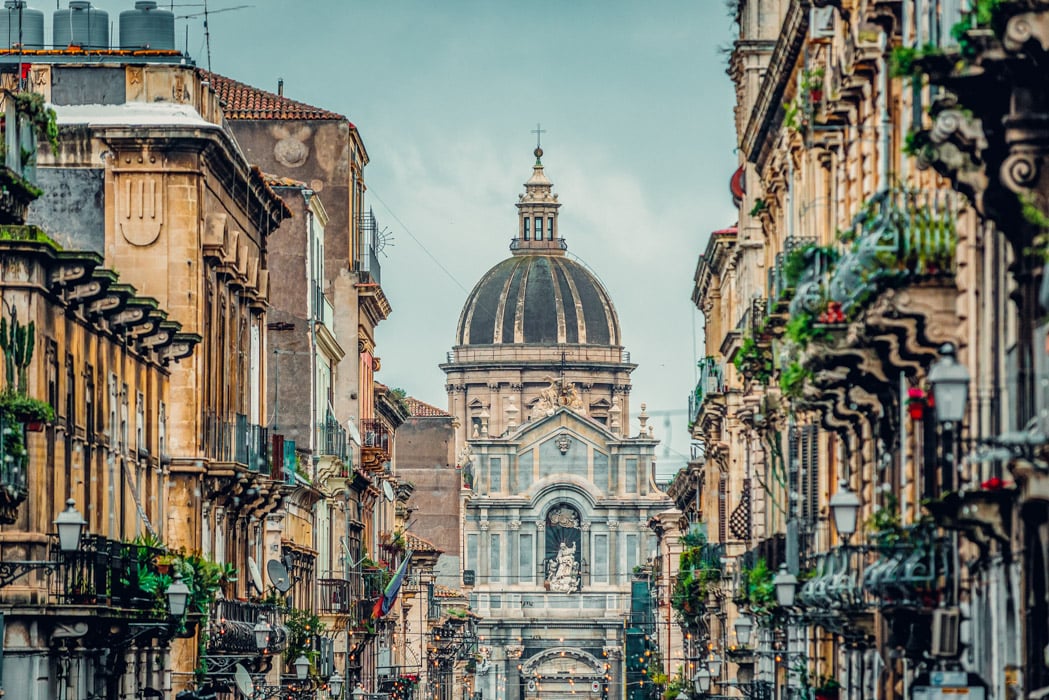
Why I Recommend East Sicily for One Week
East vs west Sicily
If you have just 7 days in Sicily, the most important decision is not which hotel to book or whether to rent a car. It is deciding whether you want East Sicily or West Sicily. Personally, I am a big fan of western Sicily, it’s more rugged, heavier on the nature side, and in general less overrun by tourists. East Sicily, however, is easier for a first-time itinerary because it ticks off more of the bucketlist items: Taormina, Mount Etna, Ortigia, and Noto.
Flying into Palermo instead?
If you are landing in Palermo, I would not try to reverse-engineer this itinerary to make it fit. Western Sicily deserves its own trip. Think of it this way: It gives you a reason to come back to beautiful Sicily.
Map of this Sicily Itinerary
Find your Sicily itinerary plotted on an interactive Google Map.
Your Route: Catania → Taormina → Catania → Mount Etna → Catania → Syracuse/Ortigia → Noto → Marzamemi → Isola delle Correnti → Catania
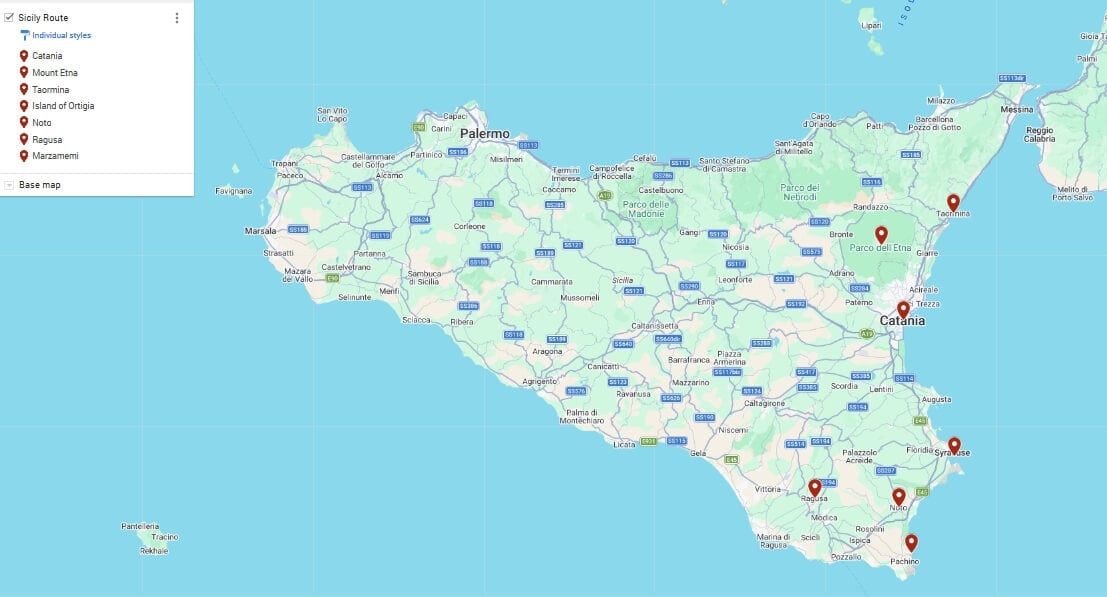
7 Day Itinerary for Sicily
This 7-day Sicily itinerary starts in Catania and focuses entirely on the eastern side of the island. Over the course of a week, you can combine Catania, Mount Etna, Taormina, Ortigia, Noto, and the southeast coast, which gives you a lovely mix of cities, baroque architecture, coastal scenery, and little villages without trying to cram in too much.
No car Sicily itinerary
Don’t feel like driving? Below are a couple of tour options that will take you to all the places mentioned in the itinerary below, without the need for a car.
- Catania – Taormina: This can be done via public transport (train)
- Mount Etna: Hiking Mount Etna and surroundings from Catania
- Ortigia: Syracuse, Ortigia and Noto w/ lunch from Catania
- Noto: Noto, Modica and Ragusa Tour from Catania
- Ragusa: Noto, Modica and Ragusa Tour from Catania
- Marzamemi: Syracuse, Ortigia, Marzamemi from Catania
DAY ONE: CATANIA

Although I know Palermo and western Sicily better, thanks to family ties on that side of the island, I ended up spending several months working remotely from eastern Sicily while still based with a Belgian company. That stretch gave me a real appreciation for this side of the island. And I can confirm it is equally magnificent, albeit more for architecture than nature.
WHERE TO STAY IN CATANIA
LUXURY: Palace Catania UNA Esperienze. A grand hotel right on Via Etnea with one of the best rooftop terraces in the city, where the views of Mount Etna are genuinely spectacular. Breakfast gets rave reviews consistently, the interiors are elegant without being stuffy, and the location puts you within walking distance of everything worth seeing in Catania.
MY RECOMMENDATION: Bastio Private Suites. Just steps from Piazza del Duomo, this intimate boutique property occupies a 16th century fortification built by Emperor Charles V, where centuries-old lava stone walls meet contemporary luxury suites complete with hammams, whirlpool baths, and private terraces. The rooftop terrace looks directly onto Catania Cathedral’s majestic dome, and the Sicilian breakfast is consistently one of the highlights guests mention in reviews.
BUDGET: Hotel Biscari. A lovely baroque-style hotel in the city centre with a rooftop terrace for breakfast, clean and spacious soundproofed rooms, and staff who go out of their way to help arrange tours and day trips. For under €100 a night it is exceptional value, and it sits just five minutes on foot from Via Etnea.
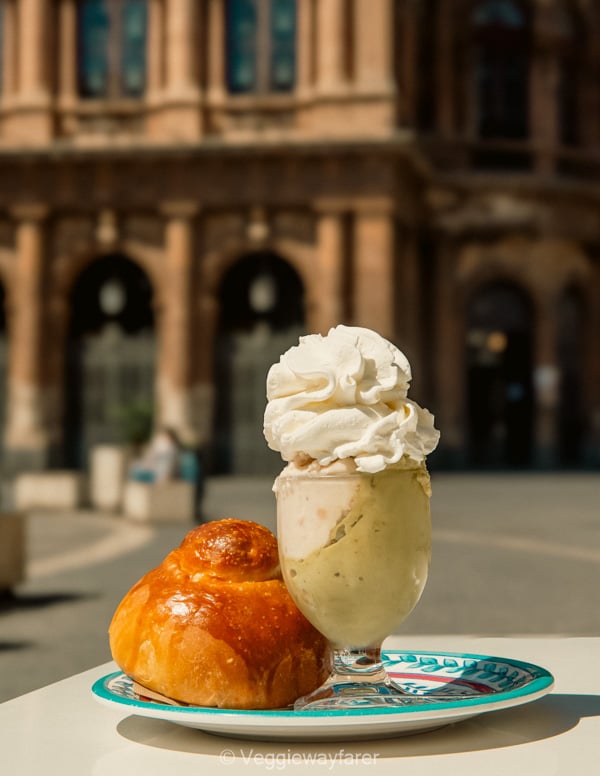

HIGHLIGHTS OF CATANIA
SEE THE TOWN SYMBOL | The beating heart of Catania and the perfect place to start is perhaps not what you might expect. The square is dominated by the Fontana dell’Elefante. As the name might reveal, it is a lava stone elephant balancing an Egyptian obelisk on its back. It has been the symbol of the city for centuries! The Cathedral of Sant’Agata flanks one side.
DUOMO DI CATANIA (CATTEDRALE DI SANT’AGATA) | Rebuilt several times after earthquakes and eruptions from Etna, the cathedral still stands as one of the finest baroque buildings in Sicily. Inside, you can see the tomb of Vincenzo Bellini as well as the relics of Sant’Agata, Catania’s much-loved patron saint. Entry is free.
CLIMB BADIA DI SANT’AGATA | Just beside the Duomo, this elegant 18th-century church is worth visiting for one reason above all: the rooftop terrace. From the top, you get sweeping views over Catania’s baroque skyline, with Mount Etna rising in the distance. Tickets cost €5, and you only need around 30 minutes for the visit.
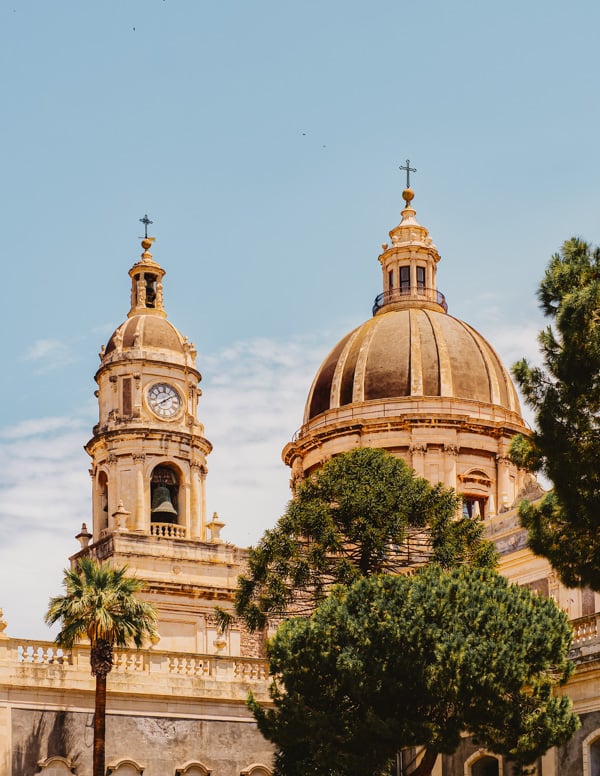

VIA ETNEA & VILLA BELLINI | Catania’s main street runs from Piazza del Duomo all the way up to the green expanse of Villa Bellini. On a clear day, the views straight along Via Etnea towards Etna are spectacular and highly photogenic. The gardens are free to enter, and it is worth climbing the two small hills inside for lovely views over both the city and the volcano.
LA PESSCHERIA FISH MARKET | Tucked just behind Piazza del Duomo, this is Catania at its loudest and most theatrical. Vendors shout over piles of swordfish, sea urchins, and deep red tuna, creating a scene that is undeniably lively, if slightly intense for a vegetarian. Go between 7 am and 10 am for the market at its busiest and without the tourists.
CASTELLO URSINO | This imposing 13th-century lava-stone castle was built by Frederick II and once stood right on the coast. After Etna’s 1669 eruption pushed the shoreline further out, it ended up stranded inland in the middle of the city. Today it houses the civic museum, with archaeological finds, paintings, and artefacts covering different chapters of Sicilian history. Entry is €6.
MONASTERO DEI BENEDETTINI DI SAN NICOLÒ L’ARENA| One of the most important historic buildings in Catania, this vast monastery is the second largest Benedictine monastery in Europe and part of the city’s UNESCO World Heritage listing. Founded in 1558 and rebuilt after both volcanic destruction and earthquake damage, it now belongs to the University of Catania. You can explore the outer gardens for free, but the real highlight is the interior, which can only be visited on a guided tour. Tours cost €10 and run daily from 10 am to 5 pm, with English tours at 1 pm and 4:30 pm.

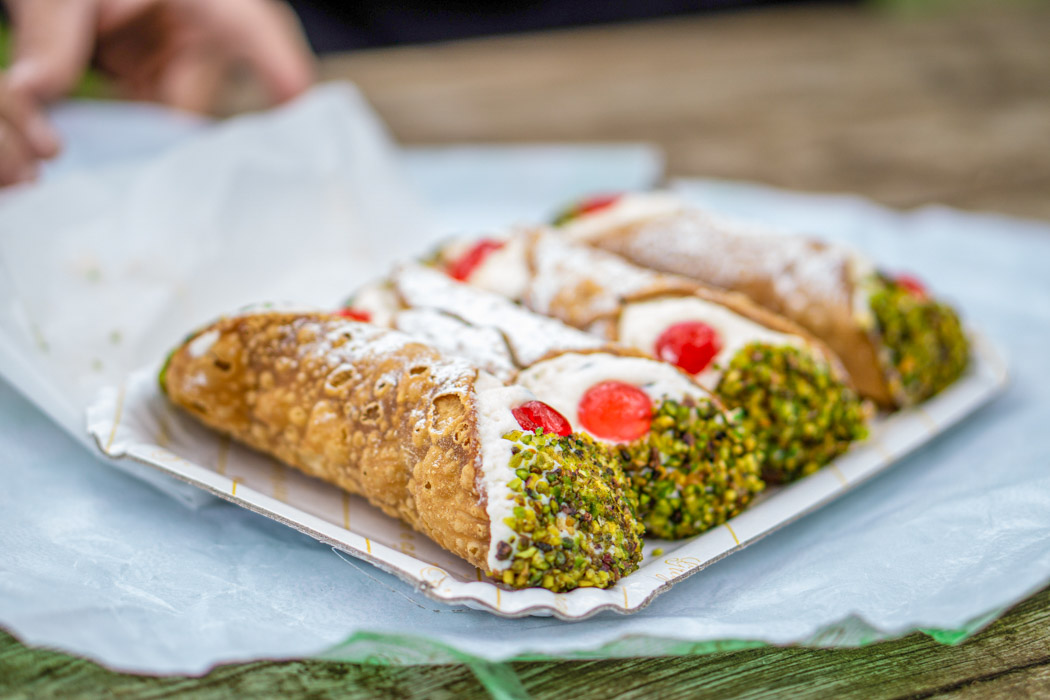
PRACTICAL TIPS FOR VISITING CATANIA
GETTING AROUND | The historic centre is compact and best explored entirely on foot — most sights are within 15 minutes of each other. Avoid the city buses unless absolutely necessary, as they are notoriously slow, overcrowded, and have no air conditioning in summer.
PICKPOCKETS | Akin to Palermo, the bustling markets of Catania tend to attract a lot of pickpockets. Be mindful of your personal items in places with a high concentration of tourists.

DAY TWO: CLIMB UP MOUNT ETNA
Even on a 7-day itinerary in Sicily, Mount Etna remains one of the few truly non-negotiable stops if you are starting in Catania. My partner has told me plenty of stories about heading up with friends armed with little more than misplaced confidence and absolutely no map, only to get lost and miss the crater entirely. Consider yourself warned: a little preparation goes a very long way here.
BOOK A TOUR TO MOUNT ETNA
TOUR OPTIONS FROM CATANIA
- Three Etna wineries with food and wine tasting (6-hour tour)
- Half day tour Mount Etna with local products tasting
- Sunset tour of Etna Park (Silvestri Craters not the summit)
TOUR OPTIONS IF YOU DRIVE TO ETNA YOURSELF
- Summit & Crater Guided Hike (does not include ticket price for cable car)
- Mount Etna quad bike adventure
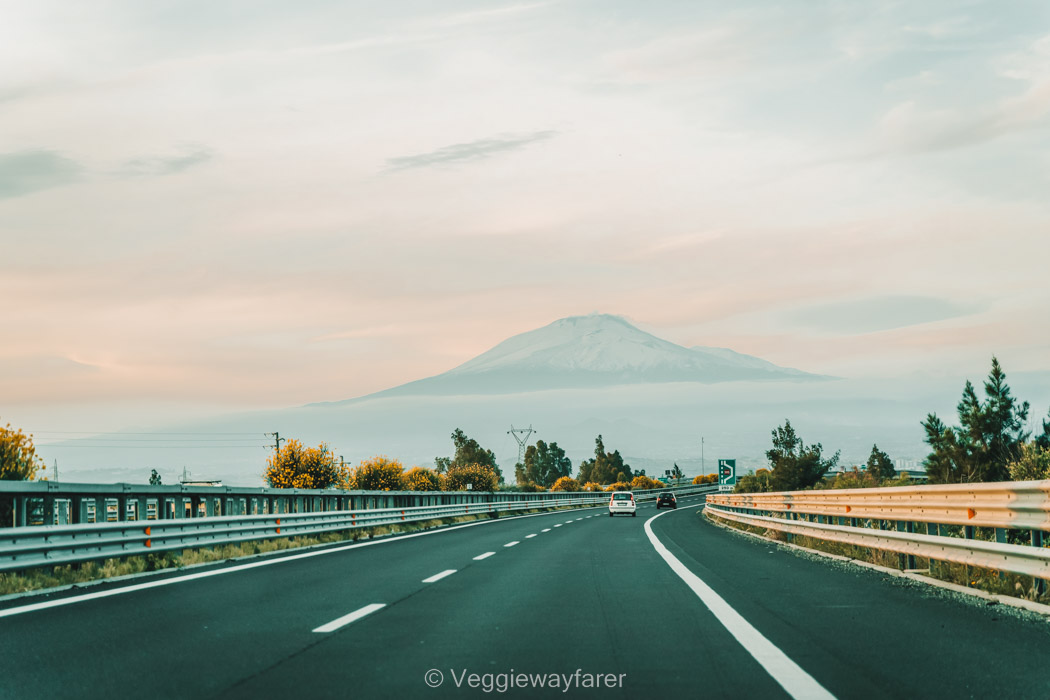
PRACTICAL DETAILS FOR CLIMBING MOUNT ETNA
No 7-day Sicily itinerary feels complete without a trip up Mount Etna, Europe’s highest active volcano and one of the island’s most unforgettable sights. Towering over Sicily’s eastern coast, Etna has a way of making everything else feel suddenly very small, especially when you see the black volcanic slopes up close and the summit hanging under a veil of smoke.
The usual starting point is Rifugio Sapienza, a mountain refuge on the southern slope at 1,900 metres. Put it straight into your GPS and you will find plenty of free parking. From here, you can keep things simple with a short, self-guided walk around the Silvestri craters, which takes around ten minutes and is completely free, or go all in with the cable car and 4×4 route up towards the crater area at 2,900 metres.
The cable car takes about 12 minutes to reach 2,500 metres and costs €50 per adult. From there, continuing by 4×4 and a mandatory guided tour to 2,900 metres costs €78 per adult in total. It is hardly cheap, but the views over Sicily and the smoking craters are more than worth it.
PRACTICAL INFO | Bring a warm jacket, whatever the season. Even in the middle of summer, temperatures at 2,500 metres can drop quickly, and the wind at 2,900 metres is far colder than you might expect. Wear sturdy closed shoes too, as the lava rock is sharp and uneven, and sandals really have no place up here.
DAY THREE: EXPLORE TAORMINA
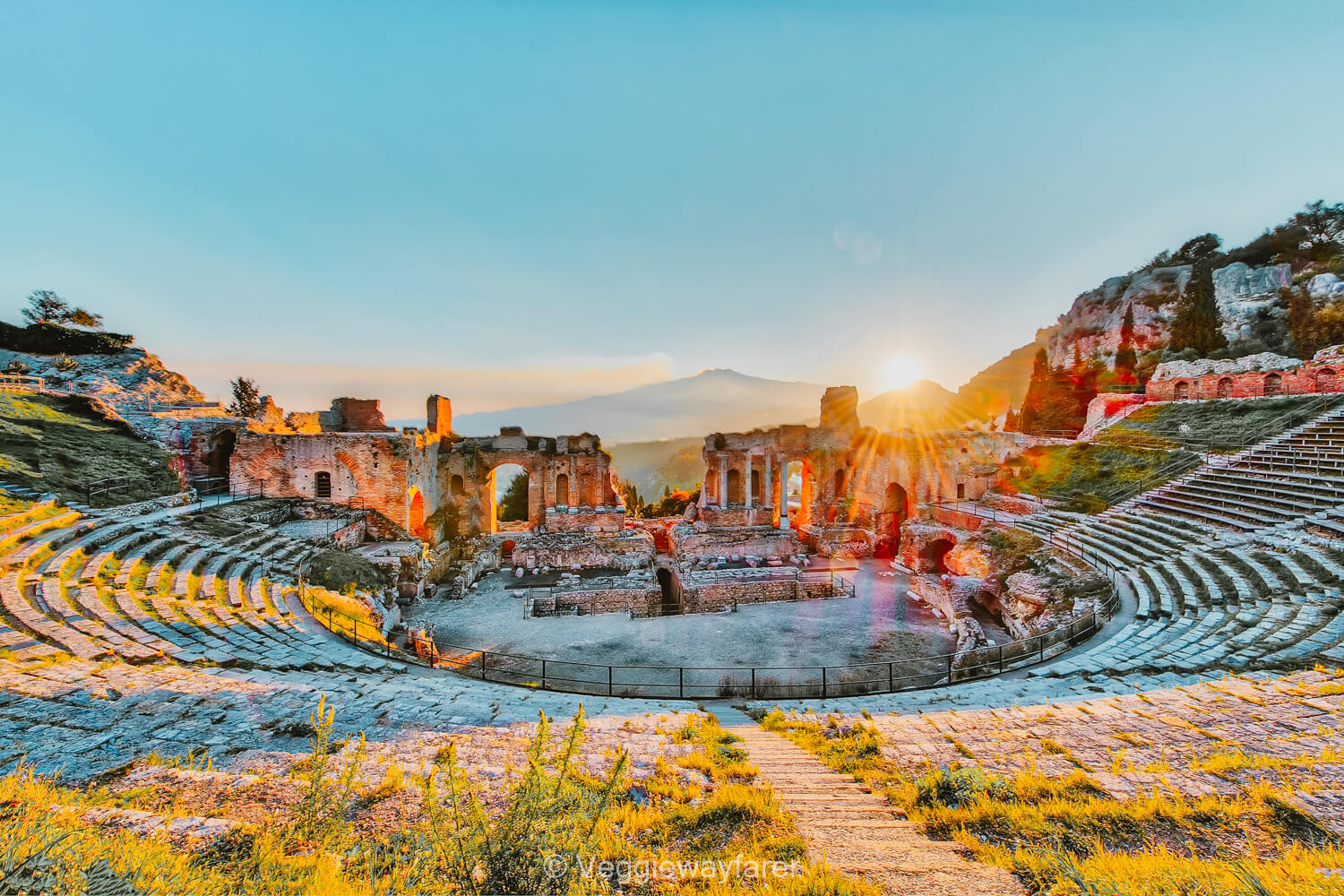
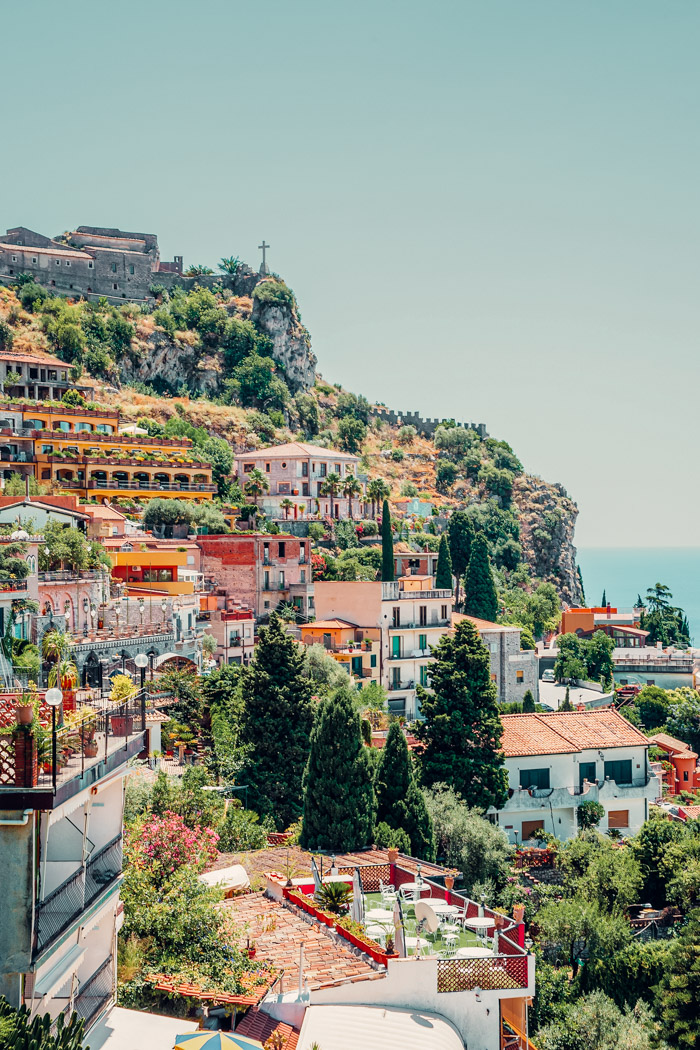
Taormina is very possibly the most beautiful town in Sicily, a medieval hillside settlement suspended high above the Ionian Sea, with an ancient Greek theatre curved around one of the most extraordinary backdrops on the island: Mount Etna rising in the distance. If you watched The White Lotus, there is a good chance the setting will feel immediately familiar.
That said, Taormina is also Sicily’s biggest crowd magnet, and in high season it can feel completely overrun with day trippers. To be totally honest, as magical as it is, I would not choose to visit in July or August. At that time of year, I would far rather spend my time in Ortigia or Noto, which feel far less hectic.
WHERE TO STAY IN TAORMINA
LUXURY: San Domenico Palace (Four Seasons). A former Dominican monastery perched in the heart of Taormina, this is the hotel that White Lotus put on the map, and it lives up to every bit of the hype. The views over the Ionian Sea are extraordinary, the service is Four Seasons through and through.
MY RECOMMENDATION: Taodomus Boutique Hotel. A beautifully designed boutique property tucked just a short walk from Corso Umberto, with a rooftop terrace that delivers some of the best views over Taormina, Mount Etna, and the coastline simultaneously. Guests consistently rave about the breakfast and the personal, attentive service.
BEST FOR VIEWS & BEACH: UNA HOTELS Capotaormina. Carved into the cliffs above the Ionian Sea just 1.5km below Taormina’s historic centre, this four-star has one of the most jaw-dropping settings of any hotel on the island. A private beach accessed by a lift cut into the rock, a saltwater infinity pool on the cliff edge, and breakfast views of Mount Etna that guests consistently describe as unforgettable.

MUST VISIT PLACES IN TAORMINA
TEATRO ANTICO DI TAORMINA | This is the headline attraction in Taormina, and one of the few places that fully lives up to the hype. Built by the Greeks in the 3rd century BC and later rebuilt by the Romans, it is the second largest ancient theatre in Sicily. What makes it unforgettable is the setting: Mount Etna smoking in the distance, with the Ionian Sea stretching out below. Go early if you can, before the tour groups arrive. Tickets cost €10 and include access to the surrounding archaeological area. Book skip-the-line tickets.
CORSO UMBERTO & PIAZZA IX APRILE | Taormina’s main pedestrian street is lined with boutiques, ceramic shops, and places to stop for granita, eventually opening onto Piazza IX Aprile. The piazza itself is one of the prettiest viewpoints in town, with sweeping views over the coast and, on a clear day, Etna in the background.
ISOLA BELLA | Taormina’s most famous beach is centred around a tiny protected island linked to the mainland by a narrow strip of sand that disappears when the tide comes in. It is one of the most photographed spots in Sicily for good reason. You can get there by cable car from town in about 5 minutes for €10 return, or walk down via the steps on Via Pirandello. If you want to visit the island itself, tickets cost €6. Go early, because it gets crowded quickly.
BAIA DI MAZZARO & SPISONE | If Isola Bella feels too busy, these nearby bays are a much calmer alternative. Both can be reached by cable car or on foot, and both have a mix of private beach clubs and public beach areas. Spisone is the larger of the two and usually feels a little less crowded, which makes it a good option for a more relaxed beach stop.
LOCAL TIP | If Taormina’s beaches feel too crowded or too expensive, head down the hill to Giardini Naxos, a lively seaside town just 5 minutes by car or bus with the longest sandy beach in the area, warm shallow water, and far more affordable lidos.

DAY FOUR: SETTLE IN ORTIGIA
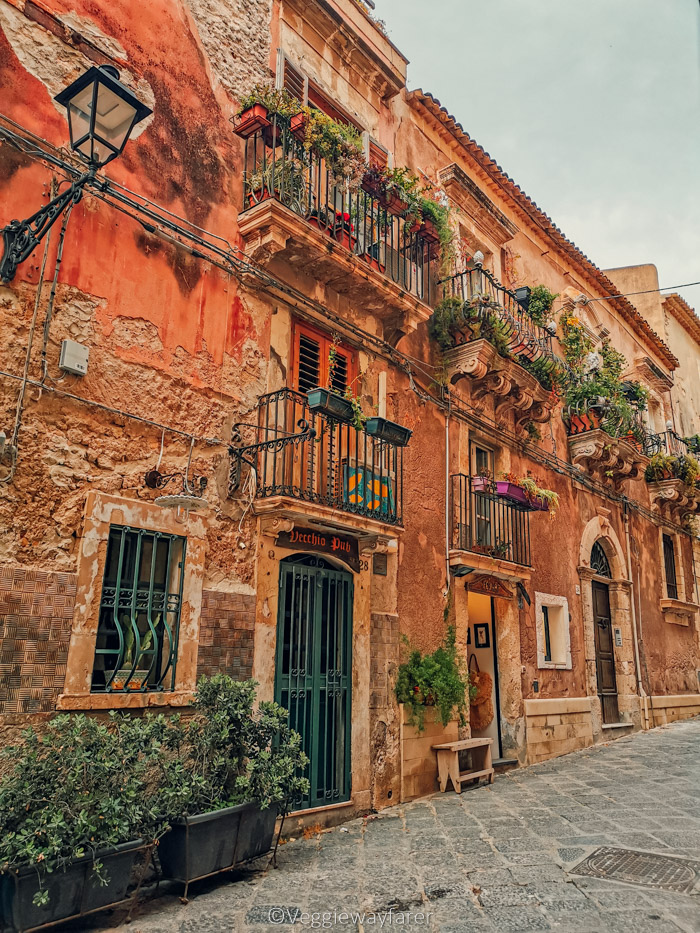
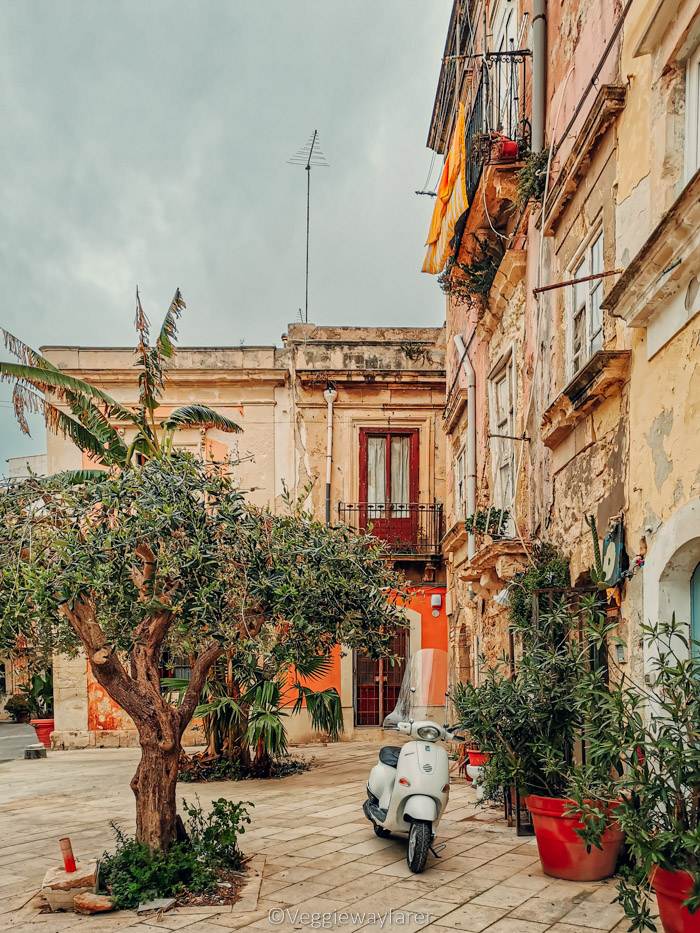
Ortigia is possibly one of my favorite places in this entire eastern Sicily itinerary. Ortigia is a tiny island linked to the mainland by two bridges, small enough to walk across in around twenty minutes, yet packed with an astonishing number of baroque palaces, sun-bleached piazzas, and elegant old façades. We spent a couple of weeks here while working remotely, and it was easily one of the most memorable parts of the trip, especially in late winter and early spring when the streets still felt calm and wonderfully lived-in.
WHERE TO STAY IN ORTIGIA
LUXURY: Palazzo Artemide. A beautifully restored palazzo right in the heart of Ortigia’s historic centre, with frescoed ceilings, marble floors, a rooftop terrace with sea views, and a spa that makes it very easy to do absolutely nothing for a day. Breakfast draws on locally sourced Sicilian produce and guests consistently rate it as one of the highlights of their stay.
MY RECOMMENDATION: Algilà Ortigia Charme Hotel. A gorgeous four-star hotel set in a historic building just steps from the sea, with stone walls, beamed ceilings, a courtyard fountain, and some rooms with private roof terraces and hot tubs. The Sicilian breakfast is excellent!
BUDGET: Hotel Gutkowski. A charming, understated hotel spread across two restored fishermen’s buildings right on the Ortigia seafront, with individually decorated rooms that mix traditional Sicilian character with a clean contemporary touch.
HIGHLIGHTS OF ORTIGIA
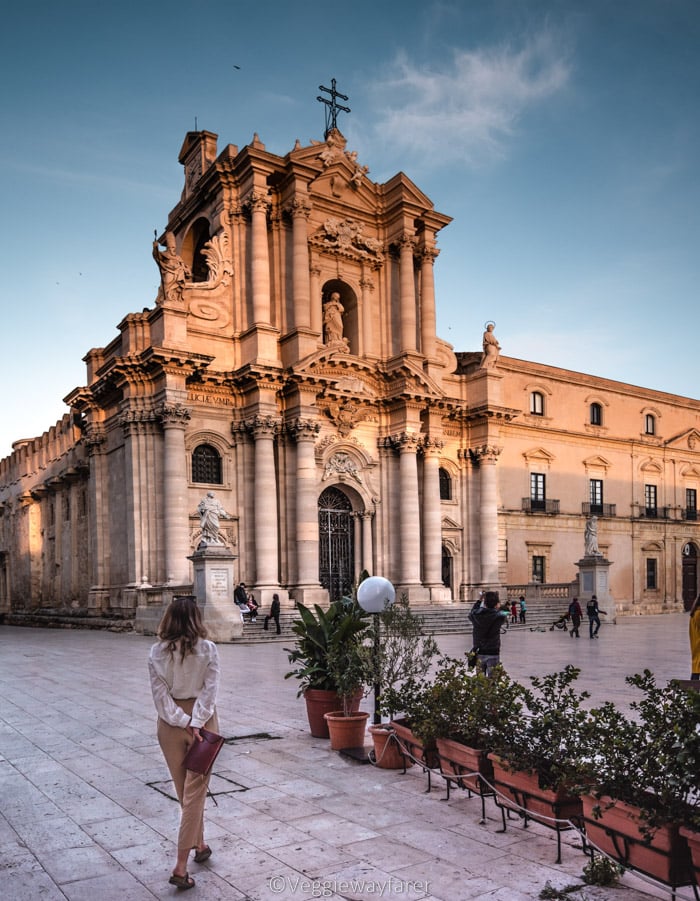
DUOMO DI SIRACUSA | Built in the 7th century directly over a 5th-century BC Greek temple to Athena, this is one of the most remarkable buildings in Sicily. If you look carefully at the outer walls, you can still see the original Doric columns of the ancient temple built straight into the structure, which makes the whole place feel like layers of history stacked visibly on top of one another. Do go inside if you can, though the piazza is especially beautiful around sunset when the light turns everything golden.
THE ORTIGIA MARKET | Every morning except Sunday, the streets near the Temple of Apollo fill with local vendors selling fruit, vegetables, almonds, seafood, and cheese in the sort of gloriously noisy chaos Sicily does so well. It is lively, messy, and completely worth embracing. While you are here, stop at Caseificio Borderi for the famously overstuffed sandwich that just about everyone seems to rave about.
SPIAGGIA CALA ROSSA & THE SEAFRONT | One of the best things about Ortigia is that the sea is never far away, and swimming from its rocky edges is part of the appeal. Cala Rossa is the island’s main beach, a small pebbly cove at the southern tip with clear water and an easy-going atmosphere. My partner used to come here in the morning just to sit by the water with a coffee, which tells you quite a lot about the mood of the place.
GALLERIA REGIONALE DI PALAZZO BELLOMO | Set inside one of Ortigia’s loveliest baroque palaces, this is also one of the most overlooked museums in eastern Sicily. The 18th-century palace contains a strong collection of medieval sculpture, Renaissance painting, and decorative arts, but truthfully, the building is half the appeal. Between the arched courtyard and the carved stone staircase, it is very easy to feel that the €8 entrance fee is worth it for the setting alone.

PRACTICAL TIPS FOR VISITING ORTIGIA
PARKING | Ortigia operates a ZTL (Limited Traffic Zone) which restricts vehicle access on weekends and public holidays, so do not even attempt to drive onto the island on a Saturday or Sunday. Your best bet is Parcheggio Molo Sant’Antonio on Via Rodi, a large pay-and-display car park just a five-minute walk from the island at €1.50 per hour. Download the EasyPark app before you arrive, as the ticket machines are notoriously unreliable and occasionally out of service entirely.
GETTING AROUND | Once you have parked, put the car keys away and explore entirely on foot. Ortigia is walkable end to end in twenty minutes, and its narrow alleyways are simply not designed for cars.
GREEK TRAGEDIES AT THE TEATRO GRECO | Every year from mid-May to late June, the INDA Foundation stages a celebrated cycle of ancient Greek tragedies at the Teatro Greco di Siracusa, one of the largest and best preserved ancient theatres in the world. Performances take place at sunset without sound systems, relying entirely on the theatre’s extraordinary acoustics. I have not made it out there yet for this event, but my partner keeps telling me we have to go!
DAY FIVE: HEAD TO NOTO
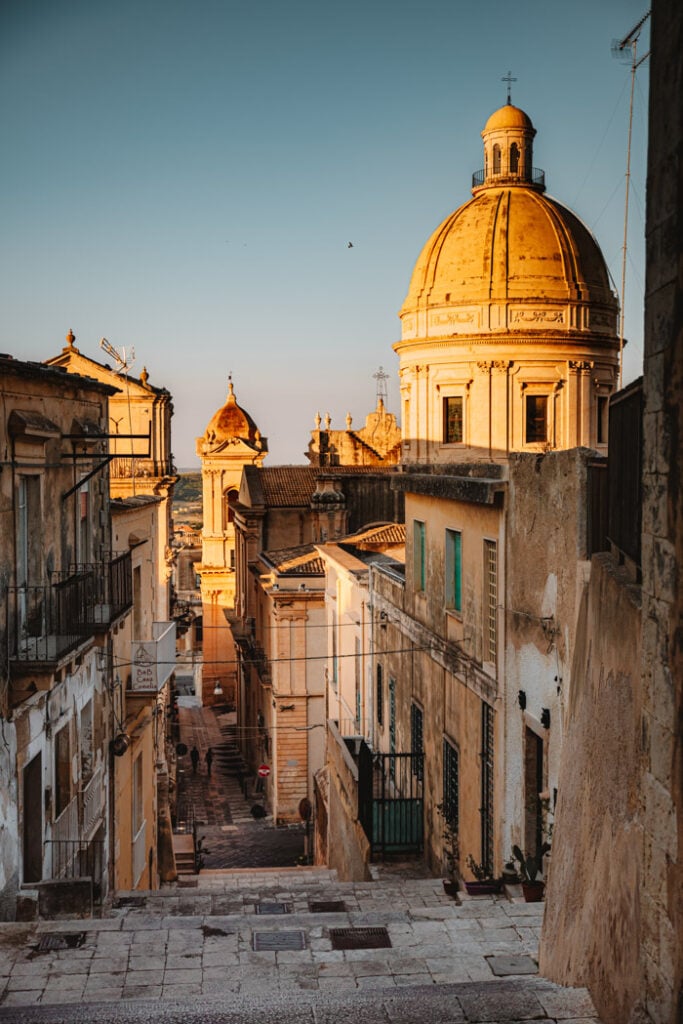
I am a complete architecture nerd, to the point that my camera roll is basically a mix of cats and ornate façades. If you are anything like me and cannot walk past a baroque palace without stopping, then Noto deserves a place on your 1-week Sicily itinerary. After a devastating 17th-century earthquake levelled much of southeastern Sicily, the town was rebuilt as a showpiece of baroque design and urban planning, and honestly, the result could hardly have been more spectacular.
WHERE TO STAY IN NOTO
LUXURY: Q92 Noto Hotel. An impeccably restored 18th century noble palazzo right on Corso Vittorio Emanuele, with just nine rooms, frescoed ceilings, bespoke furnishings, and a walled lemon garden with an honesty bar stocked with regional wines. Breakfast is served on a terrace looking directly out over Noto Cathedral, and the service is the kind that makes you feel like the only guests in the building.
MY RECOMMENDATION: Gagliardi Boutique Hotel. A beautifully restored palazzo tucked just behind Palazzo Ducezio in the heart of Noto’s baroque centre, with a rooftop terrace that delivers some of the most stunning views over the Cathedral and the city skyline. Breakfast is served in a fragrant inner courtyard, and the staff consistently earn glowing reviews for their warmth and local knowledge.
AGRITURISMO: Baglio Genovesi. A traditional Sicilian baglio about five minutes from Noto’s historic centre, with an infinity pool that sweeps out over the baroque rooftops and a warm, family-run atmosphere that is genuinely hard to leave. You will need a car to get around, but the setting, the space, and the views more than make up for it.
HIGHLIGHTS OF NOTO
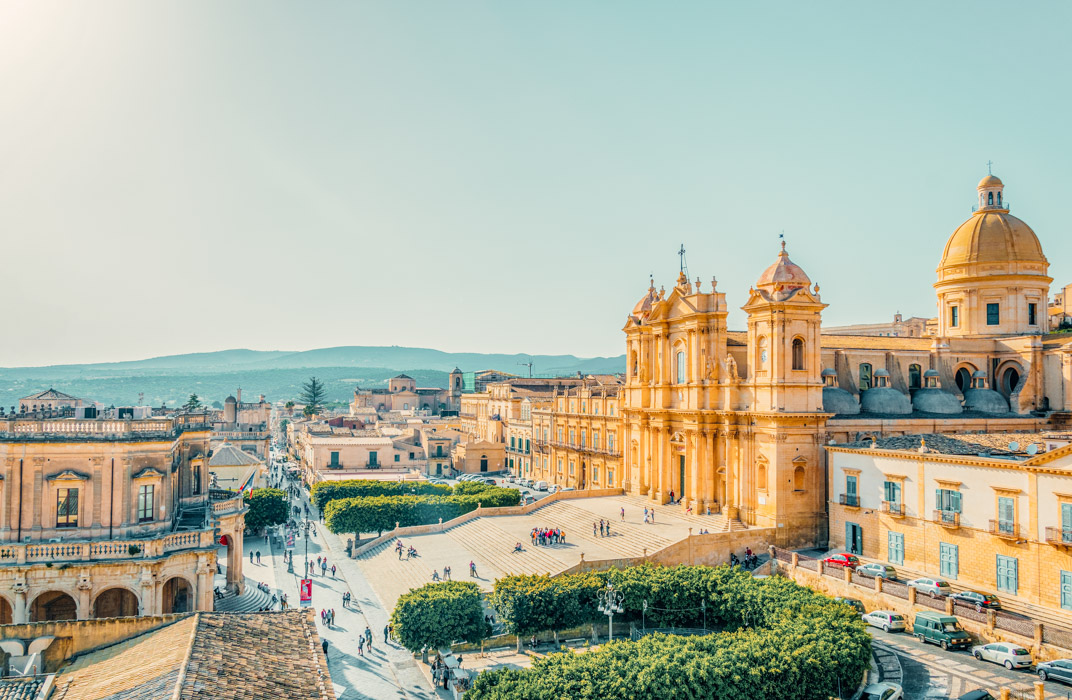
NOTO CATHEDRAL | The clear star of the city, rising above Piazza Municipio at the top of a sweeping staircase and built in the warm golden limestone that makes Noto glow at sunset. After being severely damaged by an earthquake in 1996, the cathedral was carefully rebuilt over the course of a decade using original 18th-century materials and techniques. Entry is free, and the piazza outside is a lovely place to pause with a granita from Caffè Sicilia across the street, often cited as one of the best bars in Italy.
PALAZZO DUCEZIO | Facing the cathedral, this graceful 18th-century palace now serves as Noto’s town hall and takes its inspiration from the grand residences of 17th-century France. For €3, you can head upstairs for a wonderful viewpoint directly facing the cathedral façade. The ticket also includes the Sala degli Specchi and the nearby Teatro Tina di Lorenzo, which makes it very good value.
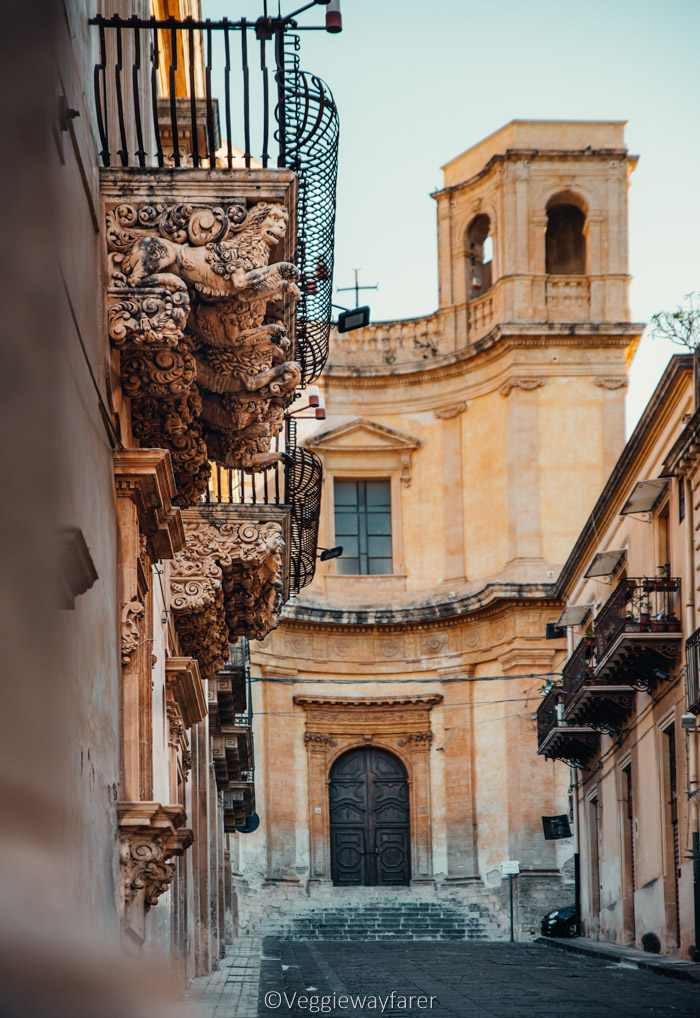
PALAZZO NICOLACI DI VILLADORATA | Stroll down Via Corrado Nicolaci and look up, because the balconies here are some of the most memorable in all of Sicily. This 18th-century baroque palace is famous for its wildly carved supports shaped like lions, horses, griffins, and cherubs. Inside are 90 rooms with frescoed ceilings, once home to the princes of Villadorata. If you happen to be here on the third Sunday of May, the street becomes the setting for the Infiorata, when it is covered in elaborate flower-petal mosaics.
CORSO VITTORIO EMANUELE | Noto’s main boulevard cuts through the historic centre from Porta Reale and is lined with churches, palaces, and café terraces all the way along. It was deliberately laid out from east to west, so the street catches the light throughout the day, which only adds to its theatrical quality. If you are here for the baroque architecture, this is the place to wander slowly with your camera firmly in hand.
BAROQUE TOUR | If you are a fan of Baroque, book yourself a private guided tour to explore the many, many Baroque palaces that are dotted around Noto. Perfect for both history and architecture buffs.

DAY SIX: SIDE QUEST TO RAGUSA
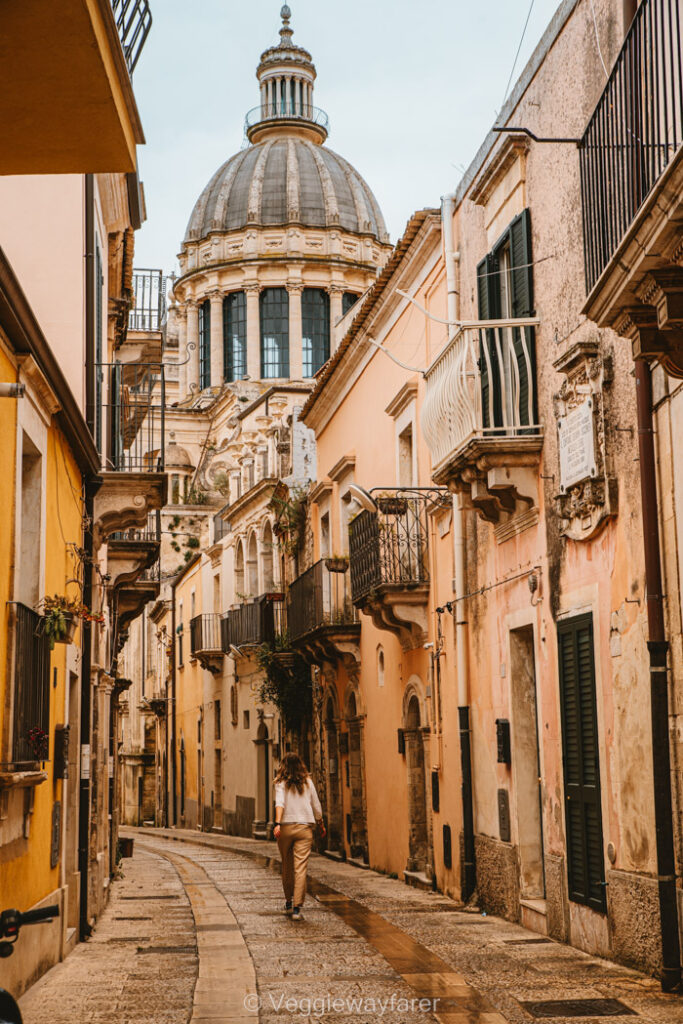
Lesser known than starlet Noto, the baroque town of Ragusa is equally magnificent. I went many years ago with my partner, and we traipsed up and down the historical town, craning our necks to look up at all the baroque balconies. What makes the city so special is the city is essentially split in two: Ragusa Superiore (the upper part of the town) and Ragusa Ibla (the older part of town, made up of little houses cascading down the hill). If you have one week in Sicily, I would plan to spend one day in Ragusa, perhaps even the night if that fits with your planning.
WHERE TO STAY IN RAGUSA
LUXURY | Antico Convento Dei Cappuccini: With just 11 rooms, Antico Convento dei Cappuccini has a much more intimate feel than a standard hotel, while its restored convent setting gives it real character. It also sits in a lovely spot for exploring Ragusa Ibla, with key sights a short walk away, so you get both atmosphere and convenience in one place.
MY RECOMMENDATION | Villa Boscarino Boutique Hotel & Spa: For a Sicily trip that calls for somewhere calm and characterful, Villa Boscarino is a lovely pick. This restored historic villa has just 14 rooms, plus a garden and outdoor pool, and while it is not right in the heart of Ragusa Ibla, it works well if you want a more peaceful base with easy parking and a short drive to the old town.
CENTRAL LOCATION | Relais Antica Badia: San Maurizio 1619: Set in an elegant 18th-century palazzo opposite San Giovanni Battista Cathedral, Antica Badia Relais is a great choice if you want somewhere with real grandeur and a central location. Guests consistently praise the beautiful breakfast room, helpful staff, and the easy walk to Ragusa Ibla, so it works well if you want a stay that feels atmospheric but still practical.
HIGHLIGHTS OF RAGUSA
DUOMO DI SAN GIORGIO | Ragusa’s most spectacular church, famous for its sweeping staircase and grand baroque façade. Even if you are only passing through, this is one of the city’s true must-sees.
PIAZZA DUOMO | The heart of Ragusa Ibla and one of the prettiest squares in the city, framed by elegant buildings and anchored by the Duomo di San Giorgio.
GIARDINO IBLEO | A peaceful garden at the far end of Ragusa Ibla, with shady paths and valley views. It’s a nice spot to hide from the blistering sun and to do a bit of people watching.
CHIESA DI SANTA MARIA DELLE SCALE | One of the best viewpoints in Ragusa, with a sweeping look over Ragusa Ibla and its layered baroque skyline. If you want one classic view for your 7-day Sicily itinerary, this is the one.
THE WALK BETWEEN RAGUSA SUPERIORE AND RAGUSA IBLA | One of the best ways to experience Ragusa is on foot. You can’t miss, start from the top of Ragusa Superiore ( Chiesa di Santa Maria delle Scale) for the panoramic view over Ragusa Ibla, then follow the steep lanes and stairways down towards Piazza Duomo. It is pretty steep, so I would recommend wearing comfortable shoes.
DAY SEVEN: MARZAMEMI AND THE SOUTHEAST COAST
For the final day of your 7-day itinerary in Sicily, I would treat the southeast coast as an optional last stop before driving back to Catania. If your flight is later in the day, this is a lovely chance to experience a quieter, less polished side of Sicily, with fishing villages, sandy beaches, nature reserves, and a much slower pace than the island’s bigger headline destinations.
WHERE TO STAY IN SOUTHEAST SICILY
MY RECOMMENDATION | Hotel Villa Giulia: If you are staying 7 days in Sicily and have ventured down to the southeast of the island, Villa Giulia is a lovely place to slow the pace. Located in the Noto countryside near San Lorenzo and Marzamemi, this restored historic borgo is known for its large pool, peaceful setting, and on-site restaurant, making it a great base for a quieter coastal stretch.
AGRITURISMO | Masseria del Carrubo: If you want somewhere a little more secluded, Masseria del Carrubo is set in the countryside outside Noto, with a 20-metre pool, spacious suites, and wide-open views across southeast Sicily. It works especially well as a base for exploring Marzamemi, Vendicari, and the Val di Noto, while still feeling calm, rural, and removed from the busier towns.
HIGHLIGHTS OF THE SOUTHEAST COAST OF SICILY
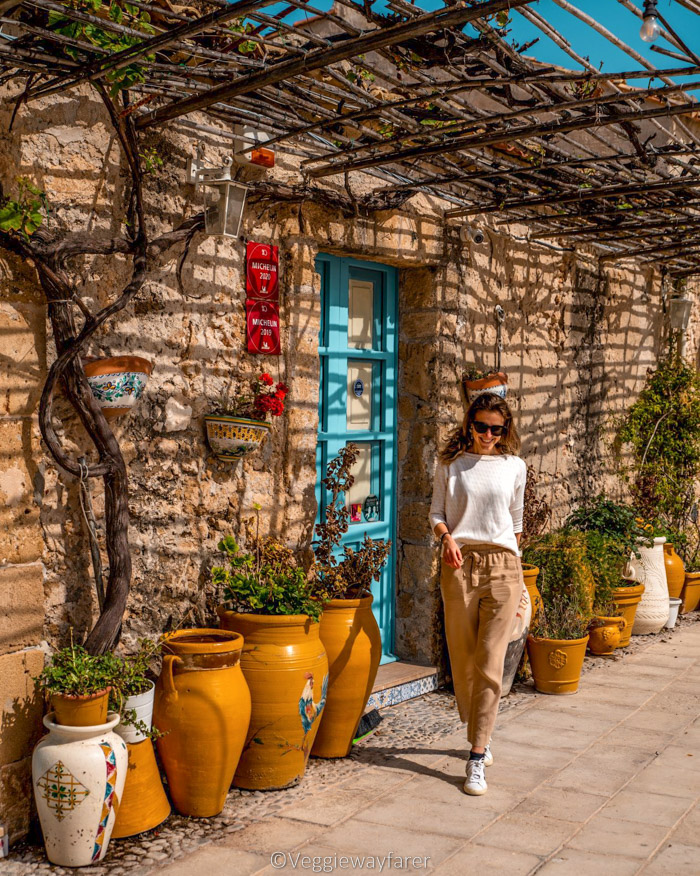
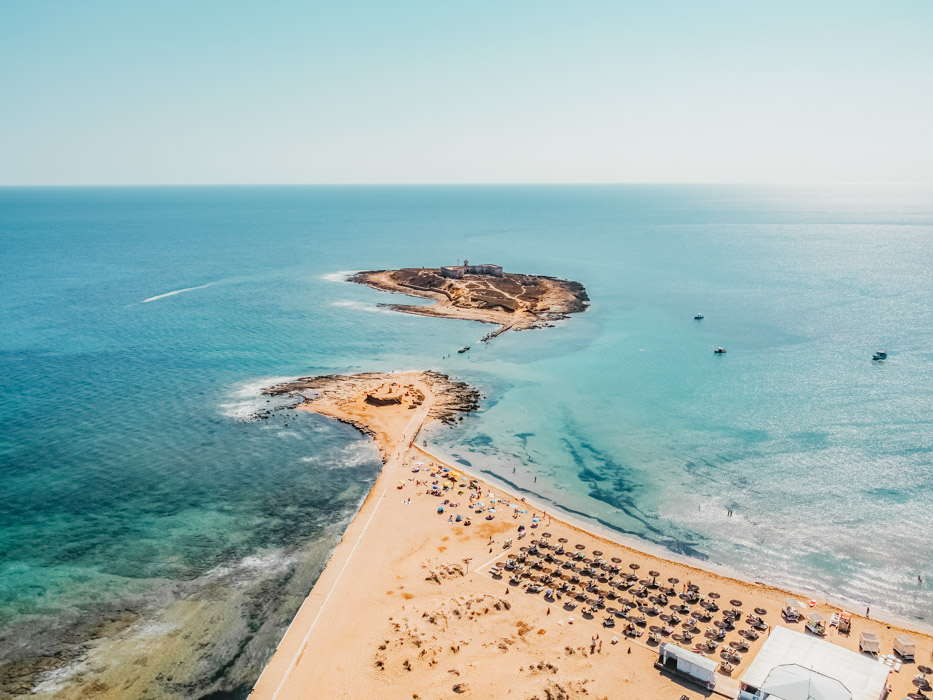
MARZAMEMI | A small fishing village with a pretty central square, faded stone buildings, and a slower, more local feel than some of Sicily’s better-known coastal stops. It is ideal for a long lunch, an evening aperitivo, or a gentle wander by the water.
RISERVA DI VENDICARI | A protected stretch of coastline with sandy beaches, walking trails, lagoons, and old tuna-fishing ruins, making it one of the most beautiful natural areas in this part of Sicily. It is especially worth visiting if you want a wilder, less built-up side of the island.
ISOLA DELLE CORRENTI | The southernmost tip of Sicily, where the Ionian and Mediterranean seas meet. The little point itself is nothing special, but the drive from Marzamemi to Isola delle Correnti is one of the prettiest stretches of road in all of Sicily. At least in my humble opinion.
Not Covered Sicily Itineraries
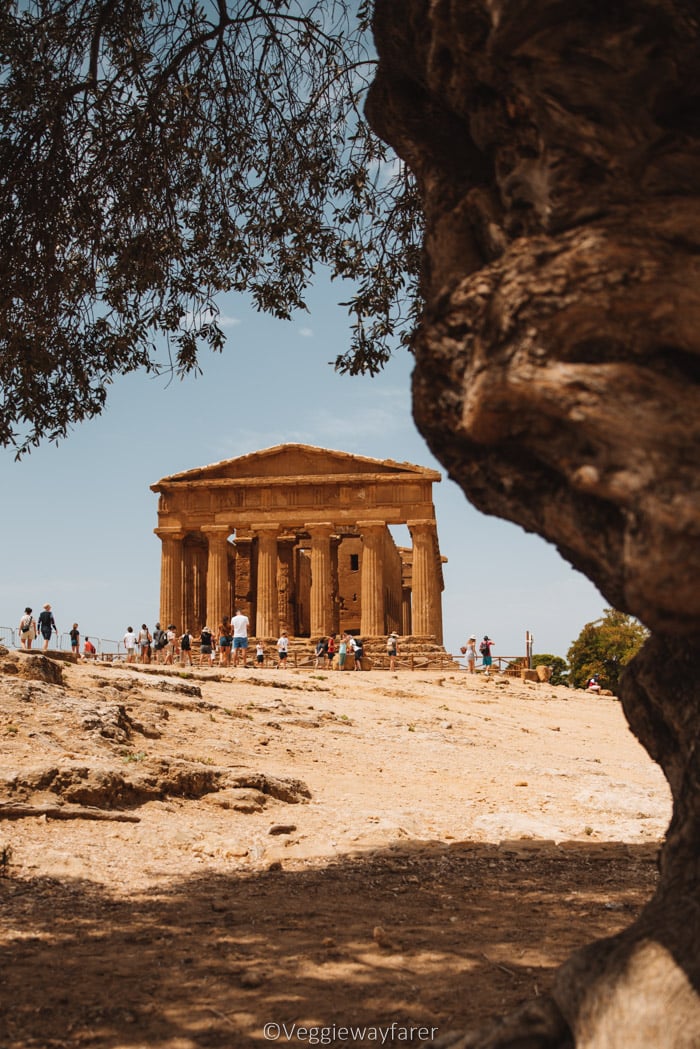
VALLEY OF TEMPLES: The Valley of the Temples is one of Sicily’s most famous archaeological sites, located near Agrigento on the island’s southern coast. It is absolutely worth seeing, but I have left it out of this itinerary because it sits too far from the eastern route to work well in just one week. Rather than adding a long cross-island drive, I would save it for a separate southern or western Sicily trip, where it can be paired more naturally with places like Scala dei Turchi.
TURKISH STEPS: Scala dei Turchi is one of those places in Sicily that has become wildly popular on Instagram, and it is easy to see why. The brilliant white marlstone cliff, curving in smooth layers down towards the sea, is genuinely striking in person. That said, it is almost 3 hours by car from Catania, so not an easy detour. If you do want to include it, it makes far more sense to pair it with the Valley of the Temples, which is only around 20 minutes away, and spread the two over 2 days.
PALERMO: As far as I am concerned, Palermo is the most beautiful place in Sicily. I might be biased, as my partner was born and raised on this part of the island. With its Arab-Norman churches, faded palazzi, lively markets, and some of the best street food in Sicily, it is a city that deserves more than a rushed stop on the way elsewhere.
LIPARI and VULCANO: These two islets are part of the Aeolian Islands, a volcanic island chain just off the northeastern coast of Sicily, reached by ferry from places like Milazzo. They are absolutely worth visiting, but I have left them out of this itinerary because they make much more sense as a dedicated island detour rather than a quick add-on. With just a week in Sicily, I think your time is better spent keeping the route on the mainland rather than losing time to ferry schedules, transfers, and extra logistics.

Best Time to Visit Sicily
SPRING (MARCH TO MAY): Temperatures sit between 14°C and 22°C (57°F to 72°F), the countryside is lush and green, and the almond trees around Agrigento bloom spectacularly in late February and early March. Crowds are manageable, prices are lower, and the light is beautiful. The Infiorata festival in Noto takes place on the third Sunday of May, when Via Corrado Nicolaci is carpeted entirely in flower petal mosaics.
SUMMER (JUNE TO AUGUST): This is peak season, with temperatures regularly hitting 30°C to 40°C (86°F to 104°F) inland and on the volcanic islands. The beaches will be absolutely packed. July and August in particular can be brutally hot for sightseeing. You will want to go early in the morning.
AUTUMN (SEPTEMBER TO NOVEMBER): My personal favourite time to visit. The heat softens to a very comfortable 20°C to 28°C (68°F to 82°F) in September and October, the sea is still warm enough to swim in, and the summer crowds thin out noticeably. October also brings the Cous Cous Fest in San Vito Lo Capo, a week-long celebration of Sicily’s North African culinary heritage.
WINTER (DECEMBER TO FEBRUARY): Cool and quiet, with temperatures ranging from 8°C to 15°C (46°F to 59°F). Most beach resorts and Aeolian island services shut down entirely, but the cities (Palermo, Catania, Syracuse) are a genuine pleasure to explore without the summer crush. We visit Palermo every year around Christmas and in recent years the city has started adding little Christmas Markets around the city.

How to Get Around Sicily
CAR: For most of Sicily, a rental car is the only realistic way to get around. Public transport outside the main cities is infrequent, unreliable, and simply not built for tourists. Many of the best beaches, hilltop villages, and archaeological sites are completely inaccessible without your own wheels. Book in advance, brace yourself for Sicilian driving culture, and note that many historic centres operate ZTL zones where driving is restricted. Compare prices via DiscoverCar.
TRAIN: Trains in Sicily are generally slow and infrequent, and most routes are not worth planning a trip around. The one exception worth knowing about is the coastline that hugs the northern shore of the island between Palermo and Messina. It is one of the more scenic train journeys in southern Italy, winding along clifftops above the Tyrrhenian Sea with the Aeolian Islands occasionally visible on the horizon. I am super happy they opened this line a few years ago!
FERRY AND HYDROFOIL: Essential if you are planning to visit the Aeolian or Egadi Islands. Liberty Lines and Siremar run regular hydrofoil services from Milazzo (for the Aeolians) and Trapani (for the Egadis), with frequency ramping up significantly in summer. Check prices and book via Ferryscanner.

FAQ — Sicily 7 Day Itinerary (First-Timers)
How many days do you need in Sicily for a first trip?
A week to ten days is the sweet spot I think. It gives you enough time to pick three bases, do a few day trips, and not feel like you are sprinting between sights. This will entail making hard choices, though. The island is a lot bigger than it might seem and the roads are not all in great condition.
Is 7 days enough for Sicily?
Yes, 7 days in Sicily is enough for a very good first trip, as long as you focus on one side of the island. A week gives you enough time to combine a few cities, coastal stops, and slower scenic moments without feeling constantly rushed. It is not enough for the whole island, which is why a focused east Sicily itinerary usually works best.
Should I fly into Catania or Palermo?
That depends on the route you want to follow. For this 7-day Sicily itinerary, Catania is the most practical airport because it gives you easy access to Mount Etna, Taormina, Syracuse, and the southeast coast. Palermo makes far more sense if you are planning a separate west Sicily itinerary.
Do you need a car in Sicily, or can you rely on trains and buses?
For this route, yes, I would recommend renting a car. Public transport works reasonably well between bigger places like Catania, Taormina, and Syracuse, but it is much less convenient for Marzamemi, Vendicari, and smaller coastal stops.
Is east or west Sicily better for first-time visitors?
For a first trip, eastern Sicily is usually the easier choice. The route gives you a strong mix of city life, baroque towns, coastline, and Mount Etna without too much backtracking. That is why this Sicily itinerary for first-time visitors focuses on the eastern side of the island. Browse through my 7 day western Sicily itinerary to see what the other side of the island has to offer.
Is Taormina worth visiting?
Yes, especially on a first trip. It is worth noting that Taormina is- often very (very) crowded, but the setting is extraordinary. Think crystalline sea views, historic streets, and the ancient theatre all packed into one dramatic hillside town. For many travellers, it is one of the clear highlights of a week in Sicily. Personally, I would try to go early in the morning if you are visiting during high season.
What is the best time to visit Sicily for good weather but fewer crowds?
October and the beginning of November are the sweet spot; the sea is still warm, the temperatures are comfortable, and the summer crowds have thinned out considerably. Late April and May are a close second, with wildflowers, cooler days, and a fraction of the August prices.
Is Marzamemi worth visiting?
Yes, particularly if you want to slow the pace towards the end of the trip. Marzamemi is very cute and about the size of a pocket square. It used to be a veritable “hidden gem” but in recent years it has become increasingly busy. It is a very worthwhile stop on an east Sicily itinerary if you enjoy coastal villages and are looking for a nice place to swim.
How many hotel bases do I need for 7 days in Sicily?
Ideally, three bases is enough, and four should be the absolute maximum. Too many hotel changes can make your trip o Sicily feel rushed, especially when distances are longer than they first appear on the map. For this route, a good split is Catania, Ortigia, and one final base near Noto or Marzamemi.
MORE TRAVEL RESOURCES FOR VISITING SICILY
ACCOMMODATION GUIDE – The best areas to stay in Sicily, and which ones to avoid!
THINGS TO DO – Quaint little villages to explore while visiting Sicily
THINGS TO DO – 20 Beautiful places in Sicily
THINGS TO DO – 15 Day trips from Catania
FOOD – Traditional Sicilian food you need to try
FOOD – Comprehensive guide to being a vegetarian in Italy including regional specialties
DRIVING – Local guide to driving in Sicily
PALERMO – A local guide to the best Palermitan street food
PALERMO – 20 Things to do in Palermo
Sicily Itinerary: Seven days in Sicily – Pin it

RELATED POSTS
 Sicily Itinerary (3, 4 & 5 Days): 2 Routes (Palermo vs Catania) + Where to Stay
 12 Things to Do in Pantelleria: A Windswept Adventure of Sicily’s Wildest Island
10 Things to Do in Vulcano: The First-Timer Guide to Sicily’s Scenic Island (+ Map)
12 Things to Do in Pantelleria: A Windswept Adventure of Sicily’s Wildest Island
10 Things to Do in Vulcano: The First-Timer Guide to Sicily’s Scenic Island (+ Map)
 Western Sicily Itinerary for 7 Days: Roadtripping from Palermo to Trapani

0 Comments